
Analysts urge greater cooperation in China-US bilateral relations
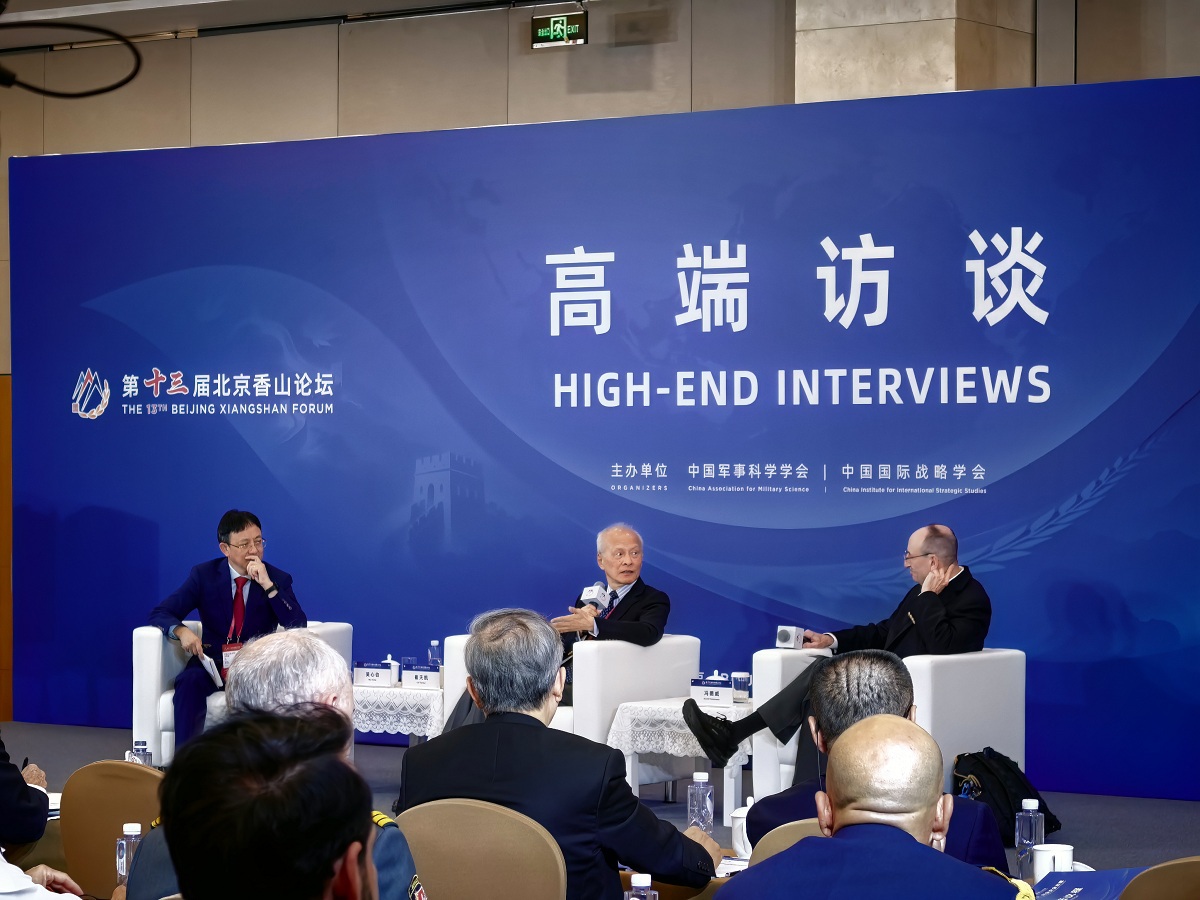
Cui Tiankai, former Chinese ambassador to the United States, engages in discussion with David Finkelstein, a distinguished research fellow at the Center for Naval Analyses in the US, at the 13th Beijing Xiangshan Forum on Tuesday. [Photo by Li Shangyi/chinadaily.com.cn]
China and the United States should turn words into action, translating their shared vision of a constructive relationship of strategic stability into dialogue across more areas and greater cooperation, analysts said at the 13th Beijing Xiangshan Forum on Tuesday.
Reflecting on China-US relations since the two countries' leaders met in May, Chinese and US analysts said bilateral relations have remained stable overall, with communication continuing between the two governments on various issues.
Cui Tiankai, former Chinese ambassador to the US, said a stable and sound China-US relationship serves the common interests of both countries.
Over the past few months, the two sides have maintained continuous communication at multiple levels through diplomatic, economic and military channels, Cui said at one of the forum's sessions.
At the May summit, the two sides agreed on a vision of building a constructive China-US relationship of strategic stability. "This is the goal set by the two presidents for the bilateral relationship," Cui said.
He said the concept of constructive strategic stability is clear from China's perspective, meaning positive stability with cooperation as the mainstay, healthy stability with competition within proper limits, constant stability with manageable differences, and lasting stability with predictable peace.
He added that China has put forward similar ideas for bilateral relations with the US over the years, including mutual respect and mutually beneficial cooperation. "China is not only talking about the same thing. We are also doing the same things," he said.
Cui also stressed that the Taiwan question is a red line, as national unity and territorial integrity are core interests of China. "The final reunification of China would solve this question once and for all and bring about lasting stability in the Taiwan Strait, which is also very much in the US interests," he said.
"Now, with the new agreement between the two presidents, hopefully the two sides can join hands to take action in the same direction," Cui said. "Though there are always problems, we'll make our best efforts to maintain overall stability."
David Finkelstein, distinguished research fellow at the Center for Naval Analyses in the US, said that while the May summit helped stabilize China-US relations, there is still a lot of work to be done.
Developing greater understanding between the two countries is critical, he said, adding that the Beijing Xiangshan Forum has provided a platform for such exchanges.
"While strategic trust may be difficult to achieve, it might be more reasonable to look for strategic stability," Finkelstein said, adding that the two countries should work together to resolve differences and cooperate in ways that prevent crises and problems from turning into conflicts.
He underscored the importance of the defense relationship between China and the US. In early September, General Yang Zhibin, commander of the Chinese People's Liberation Army Eastern Theater Command, met with US Pacific Command chief Admiral Samuel Paparo during the Asia-Pacific Chiefs of Defense Conference in Canada, marking the resumption of command-level contact after a two-year hiatus.
Strategic confidence between the two sides could be enhanced through dialogue on issues including nuclear affairs, cyberspace and hypersonic weapons, Finkelstein said.
"We need to turn the phrase into action," he said, noting that the two sides need to expand cooperation in more areas to build trust.
Cui added that while complete trust may be difficult to achieve, the two countries can build greater confidence step by step as long as they focus on doing the right things.

