Beyond mining tunnels: China's coal-rich province accelerates smarter, greener energy transition
Xinhua | 2026-10-03 21:39
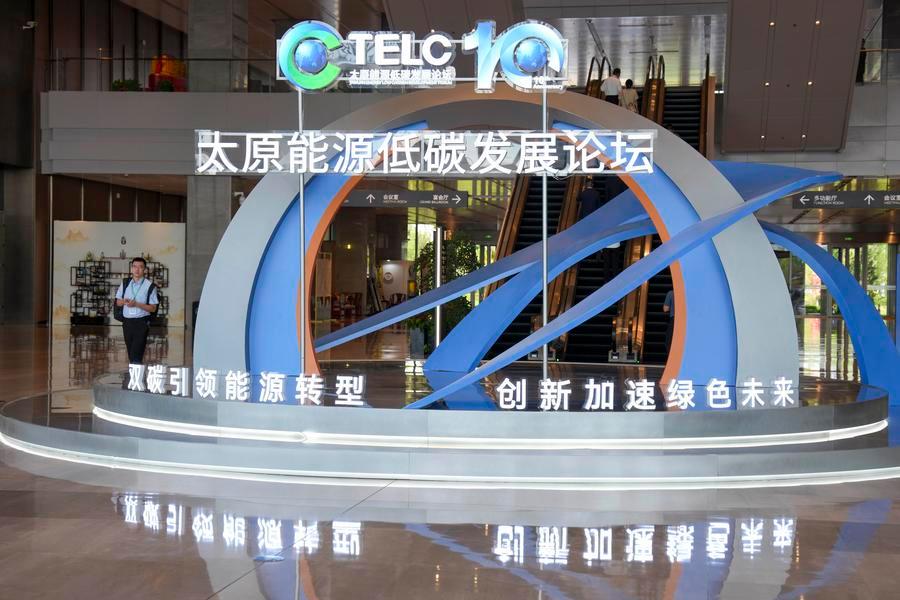
This photo taken on Sept. 4, 2026 shows a view outside the main venue of the 2026 Taiyuan Energy Low-Carbon Development Forum in Taiyuan, north China's Shanxi Province. (Xinhua/Yang Chenguang)
TAIYUAN, Oct. 3 (Xinhua) -- From intelligent coal mines to digital power-grid management, north China's Shanxi Province is accelerating its energy transition and maintaining stable coal supplies.
As one of China's major coal-producing provinces and a key national energy base, Shanxi is seeking to make its energy system smarter, more diversified and more efficient.
The province is upgrading its traditional coal industry through smarter technologies and cleaner production, while expanding wind and solar power to diversify its energy mix. Backed by increasingly flexible power management, these efforts are reshaping how Shanxi produces, supplies and uses energy as China pursues greener development.
AUTOMATED COAL MINING
For 50-year-old Zhao Huacheng, deputy head of a fully mechanized mining team at Huayang New Material Technology Group Co., Ltd., a major coal mining enterprise in Shanxi, the transformation of coal mining is evident in his daily work.
Zhao has worked in the industry for nearly 30 years, taking on almost every frontline role in his team, from coal miner and powered-support operator to safety officer.
Huayang's No. 1 Mine, with an annual production capacity of 8.5 million tonnes, is among China's first batch of intelligent demonstration coal mines. Its intelligent mining faces use 5G technology and automated equipment to enable remote control and reduce the need for underground workers.
The number of workers required underground for a shift at Zhao's team has already fallen from 24 to 16.
Operating a coal-cutting machine was once one of the toughest jobs. Three operators had to work together, with one controlling the machine from a platform and the other two observing the terrain from the front and rear.
When the machine started up, clouds of coal dust often made it nearly impossible to see, and flying chunks of coal posed a real risk of injury. Zhao still has a scar near his right eye as a reminder.
"With advances in technology, the operator in the middle is no longer needed. The operators in front and behind can control the machine remotely from six meters away, reducing the risks," Zhao said. "We used to get bumped and bruised almost constantly. Now, such incidents are rare."
Today, intelligent equipment has taken over most labor-intensive tasks. Clean mine tunnels, dust-suppression systems and enclosed control rooms have replaced the once dusty and hazardous working conditions.
Productivity has also seen a sharp increase. A production shift that once yielded about 3,000 to 4,000 tonnes of coal can now produce 5,000 to 6,000 tonnes, according to Zhao.
The transformation at Zhao's workplace is part of a broader push to make coal mining smarter and cleaner in Shanxi. By the end of November 2025, the province had built 369 intelligent coal mines, accounting for more than one-third of the national total, as well as 75 demonstration mines for green mining.
On the national level, China aims to make virtually all types of coal mines intelligent by 2035 by leveraging advanced technologies, according to the National Development and Reform Commission.
DIVERSIFIED ENERGY SUPPLY
While making coal production smarter and cleaner, Shanxi is also reshaping its energy mix, with renewable energy becoming an increasingly important source of new capacity and power generation.
At Shanxi Jinnan Steel Group Co., Ltd. in Quwo County, Linfen City, photovoltaic panels cover unused spaces ranging from rooftops and south-facing walls to hillside slopes and areas near an artificial lake.
The company produces nearly 6 million tonnes of steel annually. Over the past five years, it has invested heavily in clean energy projects to reduce the carbon intensity of its energy consumption.
Three months ago, the company partnered with PowerChina New Energy Group Co., Ltd. to develop green electricity by tapping the region's mountainous and valley resources. The two sides plan to use a "green electricity direct supply" model to better match the company's energy needs.
"We have developed photovoltaic projects with a combined capacity of 550 megawatts, generating more than 1 billion kWh of electricity annually," said Zhang Tianfu, president of Shanxi Jinnan Steel Group Co., Ltd.
Green electricity currently accounts for 15 percent of the company's power consumption. Zhang said the company will continue expanding its renewable energy portfolio and plans to raise the share to 50 percent by 2029.
The company's growing investment in green electricity comes as renewable energy has become the main source of newly added power generation capacity and electricity generation in Shanxi.
By the end of June this year, the province's installed capacity of wind and solar power had exceeded 80 million kW. In 2020, roughly one in every seven kWh generated in Shanxi came from renewable sources. Today, despite a substantial increase in total power generation, the share has risen to one in every four kWh.
A historic shift has taken place in Shanxi's energy mix. By the end of September last year, installed capacity of new and clean energy sources accounted for 54.55 percent of the province's total, marking a historic shift from a fossil-fuel-dominated energy mix toward one led by clean energy.
SMARTER POWER MANAGEMENT
As wind and solar power generation expands, Shanxi faces a new challenge: how to accommodate increasingly variable renewable generation while keeping the power grid stable.
Virtual power plants are emerging as one solution.
Shanxi Fengxingcekong Co., Ltd. operates China's first virtual power plant participating in the electricity spot market. Nan Dou, deputy general manager of the company, said the spot market generates a new electricity price every five minutes.
The virtual power plant aggregates scattered electricity-consuming resources and dispatches them through a digital platform, using algorithms to adjust the power loads of participating enterprises in response to changes in electricity prices and grid demand.
"When electricity prices are low and renewable power generation is high, we encourage enterprises to consume more electricity, maximizing the use of renewable power. When prices are high and the grid is under pressure, we organize enterprises to reduce their loads during peak periods, helping ensure safe and stable grid operation," Nan said.
"This benefits all three sides by ensuring power supplies, facilitating renewable power consumption and reducing energy costs for enterprises," he added.
From August 2023 to June 2026, the virtual power plant helped facilitate the consumption of 350 million kWh of renewable electricity, equivalent to reducing carbon dioxide emissions by about 350,000 tonnes, the operators said. It also saved about 210 million kWh of electricity.
Over the three years since entering the electricity market, the company's ability to aggregate and dispatch resources has continued to improve. The number of users on its platform has risen from five to more than 60, while its aggregated capacity has jumped from 80,000 kW to 2.282 million kW.
"The most important improvement is that our control success rate has risen from 33 percent to 80 percent. Only by improving the quality of regulation can we achieve the desired results," Nan said.
As of September 2026, 14 virtual power plants in Shanxi had participated in market trading, aggregating 1,459 users. Their combined capacity in the Shanxi electricity market had reached 6.4548 million kW, with a maximum adjustable load of 1.545 million kW.
Traditional coal-fired power plants are also undergoing flexibility upgrades in response to market signals. The upgrades allow them to reduce output when wind and solar generation is abundant, creating more room for renewable power, and quickly ramp up output when renewable generation falls short, helping ensure electricity supplies.
More than half of Shanxi's coal-fired power generating units have completed such flexibility upgrades.
"Guided by market needs, Shanxi's renewable electricity utilization rate has remained above 90 percent," said Zhang Chao, an official in charge of the spot market at the Dispatching and Control Center of State Grid Shanxi Electric Power Co., Ltd. ■
(editor:)


