
Hebei county turns trucks and screws into livestream success stories
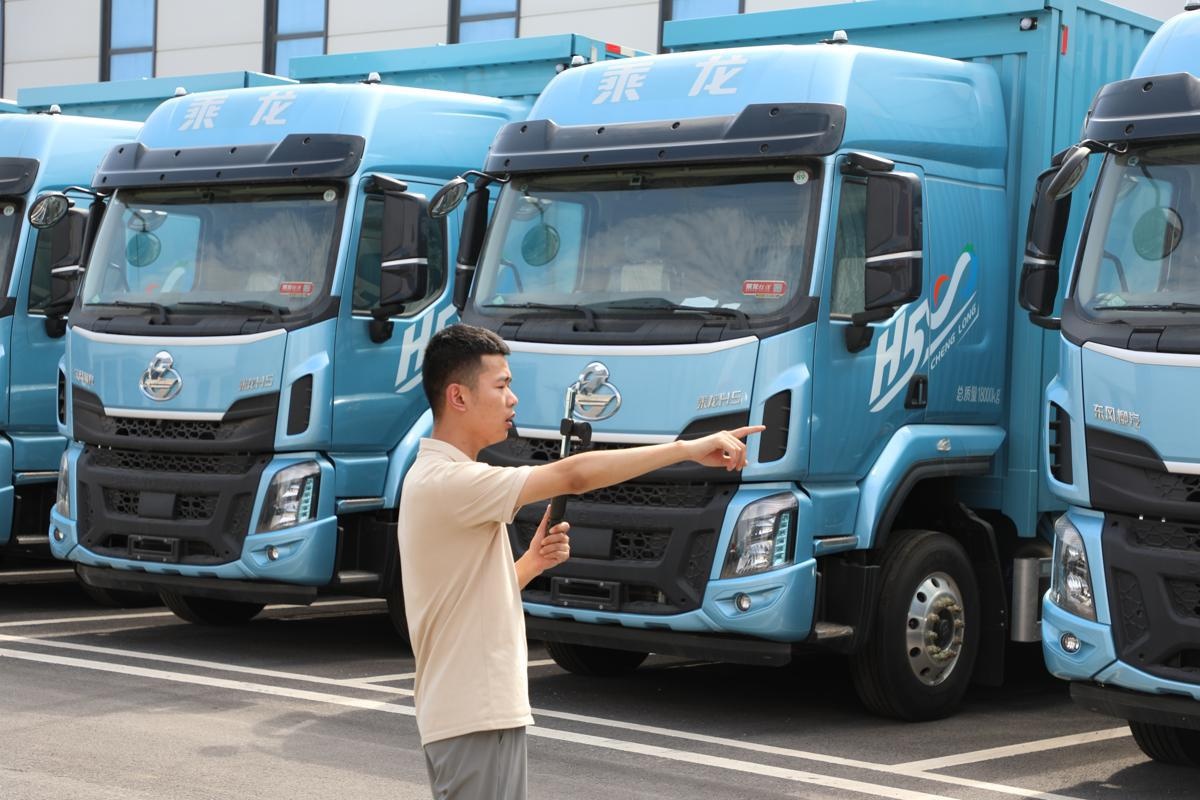
Ding Kelun, 42, traveled from Guizhou province to Cheng'an county in Handan, Hebei province, in late June to pick up his newly bought truck, a purchase he credits to a livestream by top seller Wu Ranran.
His trip reflects a broader shift underway in Cheng'an, where the county has spent the past year and a half promoting a "one product, one livestream" model that has pulled 107 industrial enterprises, ranging from truck manufacturers to fastener producers, onto livestreaming platforms, turning heavy industrial sales into a direct-to-consumer business.
Ding said he first learned of Handan Bo'ang Special Vehicle Manufacturing through Wu's Douyin account, where he picked up not only product details but also, he said, "how to reduce costs and increase profit". The two connected on WeChat to discuss specifics, and Ding drove about 20 hours to the company in April to check whether the truck was really as good as Wu had described. He closed the deal on June 28 for 400,000 yuan ($58,881).
What sold Ding, a 20-year veteran of the cargo transport business, was a safety feature: drivers no longer need to climb up the 4-meter-tall cargo box to tie ropes or cover tarpaulins, since the side curtain can be pulled from the ground. He also liked that the truck's reduced axle count saves on fuel and highway tolls. These features were enough to convince him to buy, even though the price ran about 50,000 yuan above what he'd expected.
Wu, who has built an audience of 170,000 since she started livestreaming in 2024, said sellers previously had to market trucks at places like gas stations, limiting their reach to Handan and nearby cities. "As the competition became more fierce, and the profit became less, we developed the new model on livestreaming platforms, to reach clients across the country," she said.
She initially doubted that the medium could sell something as expensive as a truck, but worked to convince viewers she was "selling a tool to make money, instead of merely a truck". The approach paid off: the company now has 20 livestream hosts, and last year sold 1,300 trucks — roughly double its volume before the change — for 350 million yuan in sales, 85 percent of it from livestreams and 70 percent from buyers outside Hebei. Wu's own show accounted for more than 100 million yuan of that total. "We couldn't have achieved results like this in a tough market without livestreaming," she said.
She added that local government support, such as training for livestream hosts and expedited license plates for buyers like Ding, has helped drive the shift.
Bo'ang is representative of how Handan, a heavy industrial city, is helping traditional industries embrace the digital economy.
In Cheng'an's "one product, one livestream" industrial park — a 7,800-square-meter complex with a logistics warehouse, product exhibition hall, 18 shared livestreaming rooms, and training classes, all free to local enterprises — cameras are trained on production lines, assembly workshops, testing labs, and shipping warehouses. From January to May, livestreaming enterprises in the county generated 15.8 billion yuan in revenue, up 15 percent year-on-year, according to local authorities.
In one room, two young women were introducing screws on camera for Yibang Machinery Technology (Handan), a fastener producer that previously sold by the ton and now sells by the piece. "Though each screw sells for about 3 yuan, and the logistics cost is about 1.5 yuan, the goal is to link directly to customers and promote our brand, so that big merchants can notice us," said Yang Jianhui, the company's chairman.
The company once relied entirely on distributors and agents, with sales teams traveling to visit clients one by one and distributors requiring large sums tied up in inventory. Now, customers place orders and settle payments instantly online, improving profit margins, Yang said.
Livestreaming industrial products isn't as entertaining as other livestream categories, Yang acknowledged, but he doesn't mind an audience of three to five people; those who stay tend to be serious buyers. The company receives about 1,000 orders a day, averaging 40 yuan each, from repair shops, processing factories, and construction teams, with a 70 percent purchase rate. Since starting last August, the company has drawn about 6,300 fans, and livestream sales now account for 20 percent of its total revenue, which reached 15 million yuan from January to March.
Guo Yanwen, director of the county's development and reform bureau, said livestreaming has become a meaningful driver of the county's industrial growth, pointing to a 9 percent year-on-year increase in added value among industrial enterprises above designated size from January to May.
The shift from B2B to B2C has also prompted companies to develop standardized, retail-friendly versions of goods once sold in bulk. A public e-commerce service center at the park now houses market regulation, finance, taxation, and administrative approval offices under one roof for e-commerce businesses. Local officials have also negotiated lower courier rates — the fee for parcels under one kilogram has dropped 36 percent, to 1.6 yuan — helping push the county's parcel volume from January to May, up 26.53 percent year-on-year.

