
China shifts cleanup focus to water at people's doorsteps
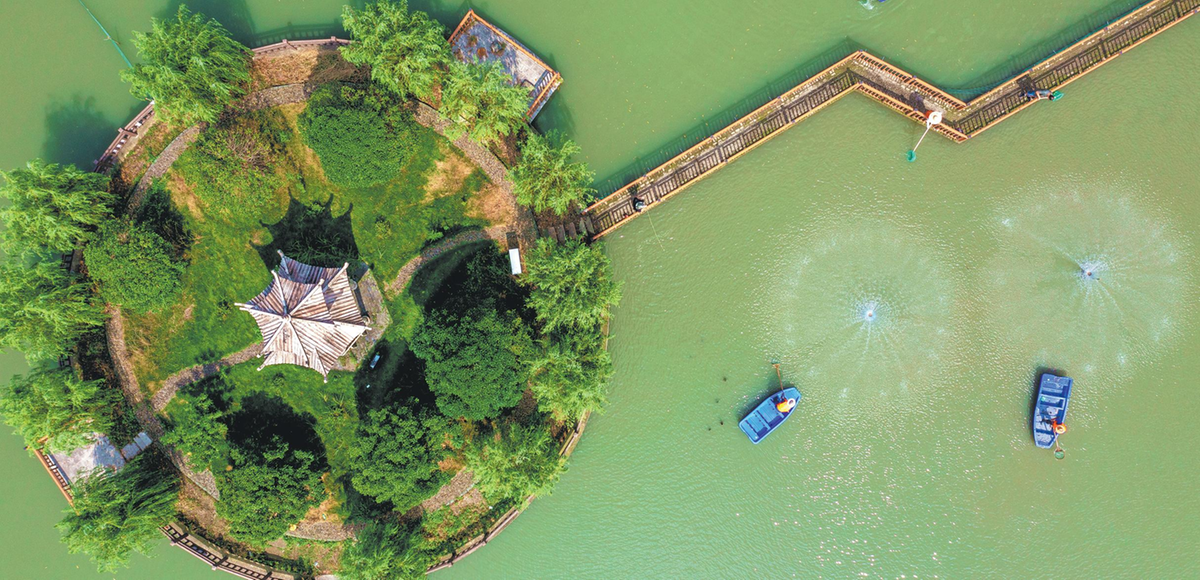
Workers clean up the surface of a pond in Changxing, Zhejiang province, in August 2023, while oxygen fountains are deployed to improve water quality. TAN YUNFENG/FOR CHINA DAILY
Editor's note: As protection of the planet's flora, fauna and resources becomes increasingly important, China Daily is publishing a series of stories to illustrate the country's commitment to safeguarding the natural world.
China has launched a sweeping national action plan targeting localized water pollution, shifting its yearslong environmental focus from major rivers and lakes to the backyard ditches, ponds, and urban tributaries that directly shape daily life.
Unveiled in mid-July by the Ministry of Ecology and Environment alongside five national bodies, including the National Development and Reform Commission, the initiative addresses smaller water bodies that are scattered, highly visible and closely tied to public comfort.
The ministry's department of water ecology and environment said such water bodies are usually small, scattered and directly felt by the public. They include urban tributaries, landscape lakes and stormwater storage ponds, as well as rural drainage ditches, streams, irrigation canals, reservoirs, ponds and weirs.
The rollout follows significant strides in large-scale water governance. In 2025, the proportion of national surface water sections with Grade I to III quality reached 91.4 percent, up 8 percentage points from the start of the 14th Five-Year Plan (2021-25). The main stems of the Yangtze and Yellow rivers have maintained high water quality standards for six and four consecutive years, respectively.
"As major rivers continue to improve, pollution in smaller tributaries, ponds and ditches has become more noticeable to the public," the department said in a media release.
China has a five-tier surface water quality system, with Grade I being the highest. Water rated Grade III is good enough for the survival of most aquatic organisms.
Under the new blueprint, Beijing has set strict targets for 2030. The plan aims to complete pollution screening and rectification in industrial parks at or above the provincial level, eliminate black and odorous water bodies across counties and townships, and bring the direct impact of livestock and poultry pollution under basic control in key regions. By the end of the decade, everyday water bodies should generally show no unusual color, unpleasant odor, or visible floating debris.
The plan calls for focused campaigns covering industrial park wastewater, black and odorous water in counties and townships, livestock manure treatment, rural river, lake and reservoir management, and the survey and rectification of small water bodies on people's doorsteps.
Industrial parks are asked in the blueprint to strengthen wastewater collection and treatment, improve environmental infrastructure and tighten supervision over rainwater outlets to prevent illegal discharge.
Counties and townships are required to identify black and odorous water bodies, make public lists of these water bodies, clarify responsible parties and adopt measures such as pollution interception, internal pollution treatment, ecological restoration and improved water circulation.
For livestock and poultry pollution, the plan emphasizes matching manure treatment facilities with farmland capacity to use organic fertilizer, while ensuring measures against rainwater, seepage and overflow.
The document also puts rural water management and small water bodies in a more prominent position. For village rivers, lakes and reservoirs, it calls for problem lists covering siltation, shrinking water areas, illegal occupation of shorelines, bank collapse and pollution. For ponds and ditches around homes, it urges graded supervision and classified treatment, including source purification, water body restoration and ecological repair.
Hu Jun, director of the Research Center for Xi Jinping Thought on Ecological Civilization, said water problems are seen in the water, but their roots are often on land.
Industrial discharge, domestic sewage, agricultural runoff and livestock waste can all enter small water bodies if they are not managed at the source, he said. This is why the plan links visible cleanup with industrial pollution prevention, urban sewage collection, cleaner aquaculture and livestock production, and stronger management of sewage outlets into rivers.
Environmental officials and experts underscored that smaller water bodies serve as the primary litmus test for public approval. Xu Qigong, president of the Chinese Academy of Environmental Planning, said small water bodies are among the most visible windows through which people judge progress in building a "Beautiful China".
Residents may not follow every monitoring indicator, he said, but they can immediately tell whether the stream beside a village is clean, whether a pond smells, or whether garbage is floating near a riverbank.
Wang Jue, director of the Shanghai Municipal Bureau of Ecology and Environment, said the plan is a concrete tool for Shanghai to practice its people-centered city concept.
For a megacity like Shanghai, she said, water environment governance is not only about meeting water quality targets, but also about whether residents are willing to walk along rivers, approach waterfront spaces and enjoy cleaner surroundings in everyday life.
Cao Shaobing, Party secretary and director of the Department of Ecology and Environment of Anhui Province, offered a more implementation-oriented reading of the plan.
Treatment measures must be carried out in individual industrial parks, along specific ditches, inside villages and around particular ponds, he said. This will help ensure that the people gain a stronger sense of fulfillment, happiness and security from the continued improvement of the water bodies in their vicinity.
To ensure compliance, the plan mandates extended monitoring networks near sewage outlets, sharper enforcement in urban-rural fringe areas, and priority handling of long-delayed public water grievances during environmental inspections.

