
Roadmap unveiled to upgrade environmental monitoring network by 2030
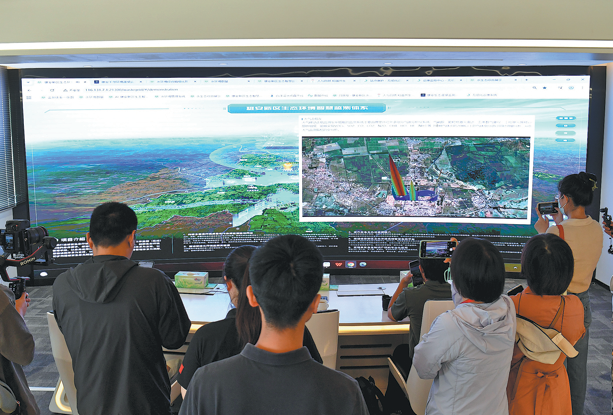
The ecology of Baiyangdian Lake in Xiong'an New Area, Hebei province, is monitored by a comprehensive system in June. HAN BING/CHINA NEWS SERVICE
A newly unveiled five-year roadmap will overhaul ecological and environmental monitoring through 2030, leveraging artificial intelligence, satellite remote sensing and automated data to power the next phase of the Beautiful China initiative.
The plan, jointly issued by the Ministry of Ecology and Environment and the National Development and Reform Commission in July, sets out key goals and tasks for environmental monitoring over the next five years. It calls for faster development of an integrated and digitalized monitoring network covering air, land, water and sea.
According to a media release from the ministry's Department of Ecological and Environmental Monitoring, since the 14th Five-Year Plan (2021-25), China has built the world's largest ecological environment monitoring network, introduced its first dedicated regulation on environmental monitoring, and started digital and intelligent transformation in the sector.
However, the release noted that the country's monitoring capacity still needs to better meet the new requirements of "Beautiful China" construction.
The Beautiful China initiative is a national strategic blueprint launched by the Chinese government in 2012 aimed at achieving sustainable economic development, environmental restoration and long-term ecological civilization.
The latest five-year plan calls for improving environmental monitoring standards, strengthening supervision of enterprises' self-monitoring responsibilities, and addressing uneven monitoring capacity across regions.
The plan envisions significant progress in building a modernized monitoring system by 2030.
The country aims to essentially build up its early warning monitoring capabilities for emerging pollutants, heavy metals and ecological issues by the end of the decade, it said. Breakthroughs are expected in key monitoring technologies, with mainstream equipment largely brought under independent development and control.
The plan includes a series of specific targets. It, for instance, aims to increase the effective rate of automated monitoring data at national monitoring stations from 95 percent in 2025 to 98 percent and lift the country's remote sensing monitoring capacity for human activities in important ecological spaces from 150,000 square kilometers per month in 2025 to 1 million sq km per month.
By 2030, the country aims to achieve 70 percent coverage in both intelligent operation and maintenance and intelligent analytical testing for key indicators.
Wu Huaimin, head of the China National Environmental Monitoring Center, said that during the 15th Five-Year Plan (2026-30), the country's environmental monitoring work will shift from simply expanding monitoring coverage to improving quality and efficiency.
Monitoring sites will be optimized to better serve densely populated areas, key pollution-control regions, townships and smaller river systems, he said.
The plan also pays more attention to emerging fields, including new pollutants, solid waste, biodiversity and greenhouse gases. It encourages wider use of automated monitoring, remote sensing, big data, artificial intelligence and unmanned equipment to improve early warning, pollution tracing and emergency response.
By 2030, a sky-space-ground-sea integrated monitoring network will be put in place, featuring systematic operation and digital-intelligent upgrades for the national network, alongside coordinated planning and seamless interconnection between central and local networks, according to the plan.
Wang Juying, director of the National Marine Environmental Monitoring Center, said the Beautiful China plan for the 15th Five-Year Plan period, which was issued by the State Council in July, has set out a framework for coordinated land-sea governance and closer interaction between nearshore and offshore protection, while calling for continued comprehensive treatment of key sea areas designated by the country.
"Most ecological and environmental problems in nearshore waters originate on land, making land-based pollution discharge a dominant factor affecting marine environmental quality," she said.
Building a new pattern of coordinated land-sea governance is both an internal requirement and a key pathway for Beautiful China construction, she said. This means the monitoring system must be able to support the whole process from pollution sources on land to receiving sea areas.
It must not only deliver a clear and accurate accounting of total terrestrial emissions, but also provide a coherent characterization of marine ecological responses — and, most critically, establish a quantifiable and verifiable response relationship between the two, she said.
Marine monitoring must therefore shift from the previous fragmented model, in which land and sea monitoring were relatively separated, to a full-chain system that connects pollution sources, transport pathways and marine ecological responses, Wang said. Such systematic monitoring capacity will be essential for supporting coordinated land-sea environmental governance.
She acknowledged that China's marine monitoring system still suffers from notable deficiencies.
While intelligent monitoring devices have yet to see widespread deployment, the integrated sky-space-ground-sea observation network also remains incomplete, Wang said.
Under complex sea conditions, monitoring coverage, timeliness and accuracy continue to fall short of requirements.
She said automated monitoring of marine biodiversity is particularly inadequate, while conventional manual methods can no longer fully support modern regulatory functions such as precise source tracing and emergency early warning.
To address these gaps, Wang said China should optimize marine monitoring models, strengthen sensing and intelligent analysis capabilities, and accelerate the upgrading of domestically developed intelligent monitoring equipment. Modern monitoring technologies, she said, will provide stronger support for marine ecological and environmental supervision.

