
Wheelchair basketball highlights evolving classification system for fair play
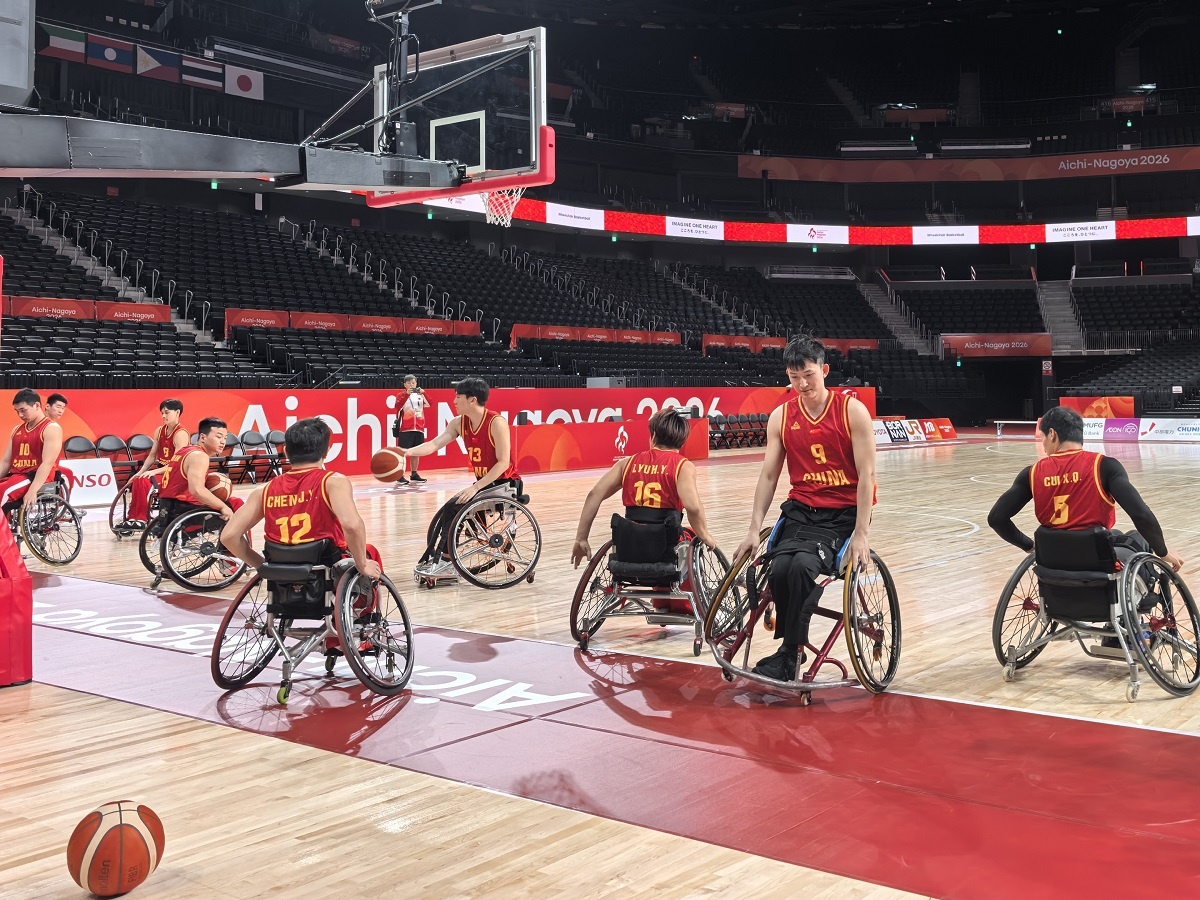
Chinese wheelchair basketball players acclimate to training at the Aichi International Arena in Nagoya, Aichi prefecture, Japan, on Wednesday. [Photo by Zhao Yimeng/chinadaily.com.cn]
As wheelchair basketball players maneuvered across the court in Nagoya, Japan, on Wednesday, battling for rebounds and creating openings for teammates, every lineup needs more than a tactical calculation.
Coaches should also balance the classification points assigned to players according to their functional abilities, ensuring athletes with different levels of impairment have a fair chance to compete.
According to the rules, the five players on court for each team cannot have a combined classification score exceeding 14 points. Individual players are assigned scores ranging from 1 to 4.5 in half-point increments, with lower scores indicating more significant impairments.
The system shows the evolution of classification in para sports, which has moved from assessments based on medical diagnoses toward evaluations of how impairments affect an athlete's ability to perform in a particular sport.
"Classification has continued to improve, moving from a medical one to functional one, and potentially toward evidence-based classification in the future," Song Yu, head of anti-doping and classification at China Administration of Sports for Persons with Disabilities, said.
"The goal is to provide athletes with a fairer competitive environment and make classification results more impartial, scientific, and accurate," Song said.
In wheelchair basketball, athletes with different conditions can compete together if their functional abilities relevant to the sport are comparable.
"What matters is the function athletes can use in the sport, rather than whether they can stand or have to remain seated," Song said.
Xue Liang, a staff member of China's wheelchair basketball team, said the classification system is designed to give athletes with both more severe and less severe impairments opportunities to contribute.
The 14-point limit requires coaches to carefully balance their lineups. A team might field three players classified at four points and two at one point, or combine three two-point players with two four-point players. Although both lineups total 14 points, they offer different tactical advantages, Xue said.
Players with higher classifications may strengthen rebounding and inside play, while teammates with lower classifications can contribute in other ways. "Coaches should consider how different combinations work together," Xue said.
Moreover, unlike in able-bodied basketball, where a coach may replace one player at a time, wheelchair basketball teams may make paired substitutions to maintain the required points balance, he added.
In individual sports such as swimming and athletics, athletes are placed in classes based on how their impairments affect performance in their events.
"Different impairment types and levels require separate classes, so para sports have more medal events than many able-bodied sports," Song said.

